

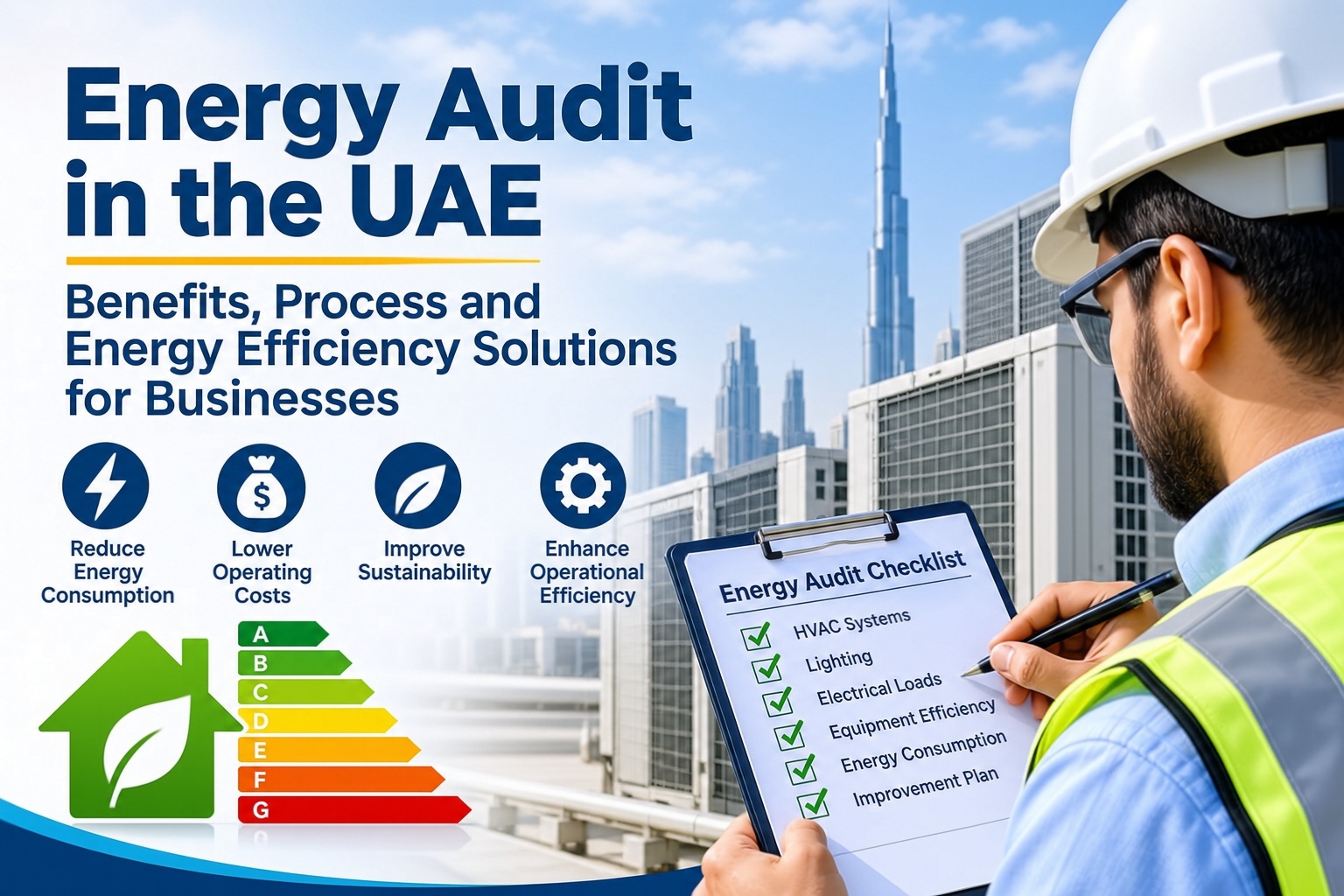
Energy Audit in the UAE: Benefits, Process and Energy Efficiency Solutions for Businesses
Introduction
Energy efficiency has become a major consideration for businesses across the United Arab Emirates. With commercial buildings, hotels, hospitals, shopping centres, offices and industrial facilities relying heavily on air conditioning, lighting, ventilation and electrical equipment, energy consumption can represent a significant part of operating expenditure.
In the UAE's hot climate, cooling systems are particularly important for maintaining comfortable indoor environments. However, inefficient equipment, poor maintenance, inappropriate temperature settings and unnecessary energy use can increase electricity consumption and operating costs.
An energy audit in the UAE helps businesses understand how energy is being consumed, identify areas of wastage and develop practical strategies to improve energy performance. By evaluating building systems, operational practices and energy consumption data, organizations can make informed decisions about energy-saving improvements.
Regulatory context: As referenced in the source document, Dubai Local Order No. 61 of 1991 – Environmental Protection Regulations; Dubai Municipality Environmental Technical Guideline No. 4 – Environmental Impact Statements for New Industrial Premises; and Ras Al Khaimah Law No. 2 of 2026. Environmental audits are mandatory in the UAE when required under the facility's environmental license, approved environmental studies, environmental management plans, or specific instructions issued by the relevant environmental authority. The frequency must be verified against the applicable permit and regulatory conditions.
For businesses looking to control operating costs, improve building performance and strengthen sustainability initiatives, professional energy audit services in the UAE provide a structured approach to identifying efficiency opportunities.
In this guide, we explain what an energy audit involves, its key benefits, the audit process, common causes of energy wastage and how businesses can implement effective energy efficiency solutions.
What Is an Energy Audit?
An energy audit is a systematic assessment of a building, facility, process or organization's energy consumption. It evaluates how energy is used, identifies inefficiencies and recommends measures to improve performance.
An energy efficiency audit typically involves reviewing utility bills, inspecting equipment, examining operational schedules and assessing the performance of major energy-consuming systems.
The objective is to understand where energy is being consumed, determine whether it is being used efficiently and identify opportunities to reduce unnecessary consumption without compromising safety, productivity or occupant comfort.
Depending on the facility and audit scope, an energy audit may assess:
✅ Heating, ventilation and air conditioning (HVAC) systems
✅ Chillers, air handling units and cooling equipment
✅ Interior and exterior lighting
✅ Electrical distribution and major electrical loads
✅ Motors, pumps and ventilation fans
✅ Building insulation, glazing and air leakage
✅ Building automation and energy management systems
✅ Equipment operating schedules and control settings
✅ Renewable energy opportunities, where appropriate
✅ Energy consumption patterns and associated costs
An energy audit report typically includes observations, identified inefficiencies, recommended improvements and, where sufficient data is available, estimated energy savings, implementation costs and potential payback periods. The depth of the assessment depends on whether the organization requires a preliminary review, a detailed building energy assessment or a comprehensive technical investigation.
Why Is an Energy Audit Important for UAE Businesses?
Energy audits help businesses move beyond assumptions about energy consumption and make decisions based on actual performance data.
1. Reduce Electricity Consumption and Operating Costs
One of the primary reasons organizations conduct energy audits is to identify opportunities to reduce electricity consumption.
An audit may reveal equipment operating outside business hours, inefficient cooling systems, excessive lighting, poorly configured controls or other avoidable energy use.
Addressing these issues can reduce electricity consumption and improve cost management.
The actual savings depend on the building's existing performance, operating conditions, proposed measures and implementation quality. An audit should establish a realistic baseline rather than promise a fixed percentage of savings.
2. Improve Air Conditioning and Cooling Efficiency
Air conditioning is a critical component of many buildings across the UAE. Cooling equipment can consume substantial amounts of energy, particularly during periods of high outdoor temperatures.
An energy audit may assess:
✅ Chiller and cooling system performance
✅ Air handling unit and fan operation
✅ Thermostat settings and control schedules
✅ Filter condition and maintenance practices
✅ Chilled water system performance
✅ Cooling demand during occupied and unoccupied hours
✅ Insulation and potential air leakage
✅ Building automation controls
These assessments help identify opportunities to improve cooling efficiency while maintaining suitable indoor comfort.
3. Identify Energy-Wasting Equipment
Equipment may consume more energy than necessary because of age, poor maintenance, incorrect settings, excessive operating hours or unsuitable sizing.
An energy audit helps identify equipment that may require maintenance, control adjustments, optimization or replacement.
This allows businesses to prioritize improvements based on their potential impact instead of replacing equipment without sufficient technical justification.
4. Support Environmental and Sustainability Goals
Reducing energy consumption can also reduce associated greenhouse gas emissions when the energy source has an emissions factor greater than zero.
Energy audit findings can support an organization's environmental management programme, carbon footprint assessment and broader Environmental, Social and Governance (ESG) objectives.
By tracking energy consumption and documenting improvements, businesses can build a stronger evidence base for sustainability reporting and internal performance reviews.
5. Improve Equipment Reliability and Maintenance Planning
Energy performance is closely connected to equipment condition and operational efficiency.
An audit may identify maintenance issues such as poorly performing motors, inefficient pump operation, obstructed filters, unsuitable control sequences or equipment running unnecessarily.
Correcting these issues can improve system performance and help organizations plan maintenance activities more effectively.
An energy audit does not replace a complete engineering inspection or equipment safety assessment, but its findings can inform maintenance priorities.
6. Support Energy Management and Regulatory Readiness
Businesses in the UAE operate within a regulatory environment that includes energy efficiency requirements, building standards and emirate-specific initiatives.
For example, Dubai's green building framework addresses energy performance in buildings, while the UAE has federal technical regulations concerning efficient energy consumption. The specific requirements applicable to a business depend on its location, activity and circumstances.
An energy audit can help organizations evaluate performance and identify potential improvement areas. However, an audit alone does not guarantee regulatory compliance or replace any mandatory approval, certification or inspection.
7. Improve Business Decision-Making
Energy audits provide useful information for budgeting and capital planning.
When recommendations include estimated costs, projected savings, expected equipment life and implementation priorities, management can compare different energy-saving measures and allocate investment more effectively.
This helps businesses distinguish between low-cost operational improvements and projects requiring substantial capital expenditure.
Key Steps in the Energy Audit Process
A structured energy audit follows a series of steps to understand current performance, identify inefficiencies and recommend suitable improvements.
Step 1: Define the Audit Scope and Objectives
The first step is to establish what the audit should achieve.
The scope may cover an entire building, selected floors, HVAC systems, industrial equipment or a specific energy-intensive process.
The auditor considers the building's purpose, operating hours, energy consumption patterns and the organization's main concerns.
Typical objectives include reducing electricity costs, improving cooling efficiency, evaluating energy management systems and identifying investment opportunities.
Clearly defining the scope helps ensure that the assessment addresses the most important energy-consuming areas.
Step 2: Collect Energy Consumption Data
The auditor reviews historical electricity bills, available meter readings and other relevant energy records.
Where applicable, the review may include:
✅ Monthly electricity consumption
✅ Electricity expenditure and tariff information
✅ Peak demand data
✅ Building operating hours
✅ Occupancy information
✅ Equipment inventories
✅ Existing energy monitoring reports
✅ Previous maintenance and audit records
Reviewing historical consumption helps establish an initial baseline and identify unusual changes or seasonal patterns. For example, if electricity consumption remains high during periods of low occupancy, the auditor may investigate whether cooling, lighting or other equipment is operating unnecessarily. Reliable data is essential for making meaningful comparisons and evaluating potential savings.
Step 3: Conduct a Site Inspection
A site inspection allows the auditor to compare documented energy use with actual operating conditions.
The assessment may include examining cooling equipment, lighting systems, pumps, motors, control panels and building management systems.
Step 4: Assess Major Energy-Consuming Systems
The next step is to evaluate the systems that contribute most significantly to the facility's energy demand.
✅ HVAC and cooling systems: Review equipment performance, temperature settings, operating schedules, maintenance condition and control strategies.
✅ Lighting systems: Assess lamp types, lighting levels, occupancy patterns, daylight availability and opportunities for efficient lighting controls.
✅ Electrical equipment: Identify high-consumption equipment, unnecessary operating hours and opportunities for better load management.
✅ Building envelope: Examine relevant insulation, windows, glazing, air leakage and solar heat gain factors that may influence cooling demand.
✅ Automation and controls: Review whether building systems respond appropriately to occupancy, operating schedules and actual demand.
The systems assessed will depend on the facility type and the audit objectives.
Step 5: Identify Energy Efficiency Opportunities
Based on the collected information, the auditor identifies potential measures to improve energy performance.
Examples may include:
✅ Replacing inefficient lighting with suitable LED systems
✅ Optimizing HVAC operating schedules
✅ Adjusting cooling setpoints appropriately
✅ Improving preventive maintenance
✅ Installing suitable occupancy or lighting controls
✅ Optimizing pumps, fans and motors
✅ Improving building insulation or reducing unwanted heat gain
✅ Introducing energy monitoring and management systems
✅ Evaluating renewable energy installations where feasible
Each recommendation should be evaluated according to its technical suitability, implementation cost, potential savings and operational implications.
Step 6: Estimate Savings and Prioritize Recommendations
Where sufficient data is available, the auditor estimates the potential energy and cost savings associated with proposed measures.
A typical evaluation considers:
✅ Current energy consumption
✅ Expected reduction in energy use
✅ Implementation and equipment costs
✅ Maintenance requirements
✅ Expected equipment life
✅ Potential disruption during installation
✅ Estimated payback period
Step 7: Prepare the Energy Audit Report
The audit report documents the assessment and provides recommendations for improving energy performance.
A well-prepared report generally includes:
✅ Description of the facility and audit scope
✅ Summary of energy consumption and costs
✅ Major energy-consuming systems
✅ Observed inefficiencies and supporting evidence
✅ Recommended energy-saving measures
✅ Estimated savings and investment requirements, where available
✅ Suggested implementation priorities
✅ Relevant assumptions and limitations
✅ Proposed monitoring and verification measures
The report provides management with a practical basis for deciding which improvements to implement first.
Step 8: Implement and Monitor Improvements
The final stage involves putting selected recommendations into practice.
Some improvements may require only changes to operating schedules or maintenance procedures. Others may involve equipment upgrades, automation improvements or building retrofits.
After implementation, energy consumption should be monitored against an appropriate baseline, with adjustments for relevant changes in occupancy, operating hours, weather and business activity.
Monitoring helps determine whether the measures are delivering the expected results and whether additional improvements are needed.
How Energy Audits Help Reduce Electricity Consumption
An energy audit creates a structured route from identifying energy waste to implementing measurable improvements.
Optimize HVAC Performance
Reviewing cooling demand, operating schedules and equipment controls can help reduce unnecessary energy consumption. Where justified, improvements may include control optimization, equipment servicing, chiller upgrades or variable-speed drives for suitable applications.
Improve Lighting Efficiency
Replacing inefficient lighting and introducing suitable controls can reduce electricity use while maintaining appropriate lighting levels. The correct solution depends on the existing installation, required illumination, operating hours and installation cost.
Introduce Smart Energy Management
Building management and energy monitoring systems can help facility teams track consumption, identify unusual loads and adjust system operation. Automated controls may be particularly useful in larger commercial buildings with multiple operating zones.
Improve Equipment Efficiency
An audit can help determine whether equipment should be maintained, optimized or replaced. Replacement decisions should consider the expected energy savings, installation cost, reliability, equipment life and any additional operational benefits.
Reduce Cooling Loads
Improvements to insulation, glazing, shading and air leakage may reduce the amount of heat entering a building. These measures should be assessed according to building design, climate conditions and technical feasibility.
Establish Energy Performance Indicators
Businesses can monitor indicators such as electricity consumption per square metre, energy use per occupied room or energy consumption per unit of production. Selecting an appropriate indicator allows organizations to compare performance more meaningfully and identify changes that require investigation.
Energy Audits for Commercial Buildings, Hotels and Industries
Energy audit requirements vary across sectors because each type of facility uses energy differently.
Commercial Offices
Office buildings typically consume energy through air conditioning, lighting, office equipment, lifts and shared building services. A commercial energy audit can examine occupancy schedules, lighting controls, HVAC performance and the operation of shared facilities. The findings can help property owners and facility managers identify practical improvements while maintaining a comfortable working environment.
Hotels and Hospitality Facilities
Hotels operate a wide range of energy-consuming systems, including guest-room cooling, kitchens, laundry facilities, lighting, hot-water systems and swimming pool equipment. An energy audit can assess these systems alongside occupancy patterns and operational schedules. For hotels, energy performance indicators may include electricity consumption per occupied room or per guest night, provided the underlying data is collected consistently.
Hospitals and Healthcare Facilities
Healthcare facilities have specialized requirements involving ventilation, temperature control, critical equipment and continuous operations. Energy-saving measures must account for patient safety, infection prevention, indoor environmental quality and clinical requirements. A detailed audit can help identify efficiency opportunities without compromising essential healthcare operations.
Industrial Facilities
Industrial energy use may involve motors, pumps, compressors, process heating, cooling systems and production machinery. An industrial energy audit can examine equipment performance, production schedules, energy-intensive processes and opportunities for operational optimization. Where production data is available, energy consumption per unit of output can help assess efficiency trends.
Retail Stores and Shopping Centres
Retail facilities may consume energy through air conditioning, display lighting, refrigeration, escalators and other shared services. An audit can identify opportunities to improve operating schedules, lighting controls, cooling performance and refrigeration efficiency where relevant.
Schools and Educational Institutions
Schools, colleges and other educational facilities use energy for cooling, lighting, computer rooms, laboratories and common areas. An audit can review energy use during teaching hours, holidays and periods of low occupancy to identify practical savings opportunities.
How to Choose an Energy Audit Consultant in the UAE
Choosing an experienced consultant helps ensure that the audit produces reliable findings and useful recommendations. Before appointing an energy audit consultant in Dubai or elsewhere in the UAE, consider the following factors.
1. Relevant Technical Experience
Look for a consultant with experience in facilities similar to yours. A hospital, hotel, industrial plant and office building have different energy demands and operational constraints.
2. Clear Audit Methodology
The consultant should explain the audit scope, information requirements, inspection approach, measurement methods and expected deliverables. For larger or more complex facilities, ask whether the assessment includes detailed system analysis and energy monitoring.
3. Evidence-Based Recommendations
Recommendations should be supported by consumption data, technical observations and transparent assumptions.
4. Practical Implementation Planning
A useful audit report should distinguish between immediate operational improvements, maintenance actions and longer-term capital investments. Recommendations should also account for operational disruption, equipment compatibility and implementation priorities.
5. Savings Assessment and Verification
Ask how estimated energy savings will be calculated and how results can be monitored after implementation. A suitable measurement and verification approach helps organizations compare actual performance with expected outcomes.
6. Relevant Qualifications and Accreditation
Where required by a particular programme, authority or project, verify the consultant's relevant licences, qualifications and accreditation. For regulated or specialized work, confirm that the service provider meets the applicable requirements before proceeding.
7. Transparent Scope and Pricing
The quotation should explain what is included, such as site inspections, data analysis, measurements, reporting, follow-up support and any additional testing. Clear scope definition makes it easier to compare proposals and avoid unexpected costs.
Energy Audits and Sustainability in the UAE
Energy efficiency is an important component of the UAE's wider sustainability agenda. The UAE's official energy efficiency framework discusses measures to improve resource use, while Dubai's green building regulations address energy performance in buildings. The applicable standards and obligations vary according to location and project circumstances. Businesses can use energy audit findings to support several sustainability objectives.
Reduce Energy-Related Carbon Emissions
Reducing electricity consumption can lower associated emissions when calculated using an appropriate emissions factor and defined reporting boundary. Organizations seeking to quantify their carbon footprint should document energy data, select suitable emissions factors and apply a consistent methodology.
Support ESG Reporting
Energy consumption and efficiency improvements can form part of environmental performance reporting. Reliable records of energy use, reduction initiatives and measured results help businesses provide more transparent information to relevant stakeholders.
Improve Operational Sustainability
Energy efficiency measures can reduce resource consumption and support more effective building management. When combined with suitable maintenance, monitoring and management practices, an energy audit can become part of an ongoing sustainability programme rather than a one-time assessment.
Support Long-Term Energy Management
Organizations can establish energy baselines, assign responsibilities, set improvement targets and monitor performance over time. This approach helps integrate energy efficiency into everyday decision-making and capital planning.
What Does an Energy Audit Cost in the UAE?
The cost of energy audit services in the UAE depends on the size and complexity of the facility and the level of technical investigation required. Factors affecting the cost may include:
✅ Building area and number of locations
✅ Number and complexity of energy-consuming systems
✅ Availability and quality of historical energy data
✅ Requirement for equipment measurements or temporary monitoring
✅ Industrial processes and specialized equipment
✅ Reporting requirements and expected deliverables
✅ Follow-up analysis or implementation support
A preliminary assessment may require less time and fewer resources than a detailed audit of a large industrial facility or multi-building property portfolio. Businesses should request a proposal based on their specific requirements rather than rely on a generic price estimate.
Frequently Asked Questions About Energy Audits in the UAE
An energy audit is a structured assessment of a building, facility or process to understand energy consumption, identify inefficiencies and recommend improvements. It can help businesses reduce avoidable energy use, improve operational performance and support sustainability objectives.
Businesses in Dubai can use energy audits to identify electricity wastage, evaluate cooling and lighting systems, improve equipment performance and prioritize energy-saving investments. Audits can also help organizations review their energy performance in the context of applicable building standards and sustainability initiatives.
Energy-related obligations depend on the applicable federal and emirate-level regulations, building requirements, sector, facility and specific programmes. Not every business should assume that the same audit requirements apply to it. Organizations should confirm their obligations with the relevant authority or a qualified consultant.
The duration depends on the size of the facility, the complexity of its systems, the availability of energy records and the required level of analysis. A preliminary review may be completed more quickly than a comprehensive audit involving detailed measurements and extended monitoring.
Common areas include air conditioning, chillers, ventilation, lighting, motors, pumps, electrical equipment, building controls and the building envelope. The auditor selects systems according to their energy significance and the objectives of the assessment.
An energy audit can identify opportunities to reduce energy consumption and associated costs. Actual savings depend on the existing condition of the facility, the measures implemented, operating patterns, electricity tariffs and the effectiveness of ongoing monitoring.
A typical report includes the audit scope, energy consumption review, site observations, identified inefficiencies, recommended measures and implementation priorities. Depending on the scope and available data, it may also include estimated savings, investment costs and payback calculations.
Common documents include historical electricity bills, meter readings, equipment inventories, building plans, operating schedules, maintenance records and existing energy monitoring reports. The exact requirements depend on the facility and the depth of the audit.
There is no single frequency that applies to every facility. Businesses should follow any applicable regulatory or programme requirements and consider periodic reviews based on energy consumption, operational changes, equipment upgrades and previous findings.
An energy audit is an assessment designed to identify energy performance issues and improvement opportunities. An energy management system is an ongoing framework for monitoring, managing and improving energy performance through defined responsibilities, procedures, objectives and reviews.
Yes. Energy audit findings can help organizations identify reduction opportunities and improve the quality of their energy consumption data. For carbon reporting, the organization should apply an appropriate calculation methodology and relevant emissions factors rather than treat audit estimates alone as verified emissions reductions.
Energy audit consultants can support commercial buildings, hotels, hospitals, educational institutions, industrial facilities, retail properties and other organizations seeking to understand or improve their energy performance. The consultant should have suitable experience and qualifications for the facility and the required scope of work.
Conclusion: Improve Energy Efficiency with a Professional Energy Audit
Energy efficiency is both an operational priority and an important part of responsible business management. For organizations across the UAE, an energy audit provides a structured way to understand consumption patterns, identify avoidable energy use and evaluate practical improvements.
From optimizing air conditioning and lighting to improving equipment controls and planning energy-efficient upgrades, audit findings can help businesses make informed decisions about reducing operating costs and improving building performance.
The most effective approach combines reliable energy data, a clear audit scope, technically sound recommendations and ongoing performance monitoring. Rather than focusing only on short-term savings, organizations should use audit findings to develop a practical, measurable energy management strategy.
Looking for professional energy audit services in the UAE? ESG Consultants UAE can help your organization explore energy efficiency opportunities, assess environmental performance and identify suitable sustainability improvements. Contact the team to discuss your facility, energy consumption challenges and audit requirements.
Website: https://www.esgconsultants.ae/
Take the next step towards smarter energy management, improved efficiency and more sustainable business operations.
Explore Professional Energy Audit Services in the UAE.
Contact Information
Website: https://www.esgconsultants.ae
Email: info@esgconsultants.ae
Phone: +971 52 416 9197